
Before Opening in Vietnam: 5 Catchment Checks for a Ho Chi Minh City Store
Check target customers, travel routes, dayparts, alternatives and social media interest before choosing a store location in Ho Chi Minh City.
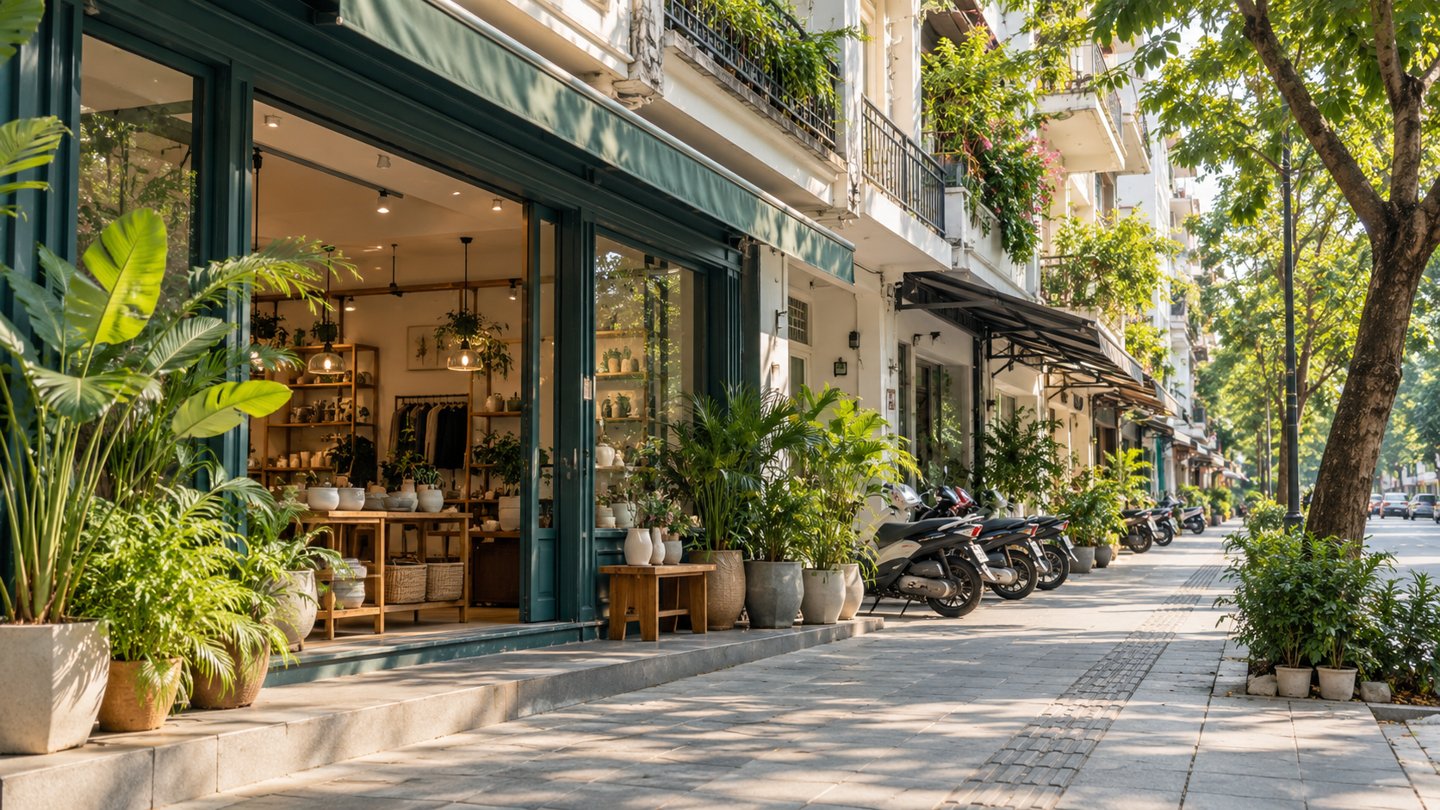
Cover: AI-generated image, not a photograph of a real property, client or interview location.
Before comparing premises for a store in Vietnam, define who will use it, for what purpose and at what times. Test that hypothesis against local movement patterns, nearby businesses and ease of access. This is the starting point for catchment research.
This article offers practical suggestions for Japanese entrepreneurs planning a restaurant, retail or service outlet in Ho Chi Minh City, and companies considering store expansion in Vietnam.
What opening announcements cannot tell us from a city name alone
On October 19, 2026, VIETJO reported GiGO's expansion into Thanh Hoa Province. An October 16 press release from GENDA GiGO Entertainment also announced the new location with an opening date of October 18. The reporting and announcement dates therefore differ from the stated opening date. [Sources 1–2]
AEON MALL's official introduction to AEON MALL Thanh Hoa describes a family-oriented facility combining shopping, dining and entertainment. [Source 3]
What interests us is the attention to local circumstances and the purpose of a visit, rather than simply opening in Vietnam. However, this information does not establish demand or profitability for a small Ho Chi Minh City store. A major company's opening is not evidence that your own business will succeed.
Using the news as a starting point, WIREDREAM VIETNAM proposes the following checks before choosing a location.
1. Define customers beyond nationality
Move beyond “Japanese customers” or “Vietnamese customers” to describe their daily area and reason for visiting.
A weekday lunch for nearby workers, a family meal at the weekend and a business dinner require different service times and seating. These are planning examples, not claims about demand in a particular district.
Start with one target group and state why that person would choose your store. For product sales, clarify not just who buys, but whether the item is for home, gifting or business use.
2. Assess travel routes as well as distance
A nearby point on a map may not be easy to reach because of its entrance or actual travel route. Walk toward each candidate from the direction your customers are likely to approach.
- Are the building entrance and store easy to identify?
- Can customers arrive conveniently on foot, by motorbike or by car, as intended?
- What parking, pickup/drop-off and delivery conditions require confirmation?
- Will access or waiting space be inconvenient in rain?
Confirm property and facility conditions with a responsible party such as the manager. Do not assume parking or loading is permitted based only on a viewing.
3. Observe different days and times
Do not label a location busy after one visit. Observe at times relevant to your planned opening hours and compare different conditions, such as a weekday lunchtime and a weekend evening.
Useful observation notes include:
- Date, time, weather and nearby events: could the day's conditions distort your impression?
- Movement and stopping points: where might people notice the store?
- How nearby businesses are used: meals, breaks, shopping or another purpose?
- Questions asked and who answered: separate impressions from confirmed conditions.
- Follow-up checks: keep unresolved issues visible.
Foot traffic is not the same as your future customer count. State the limits of your observations and avoid inferring income or spending power from appearance.
4. Include alternatives outside your business category
Competitors are not only stores selling similar food or goods. Include other places customers could choose with the same time and budget.
For family weekend visits, consider other nearby activities as well as dining. For retail, consider why customers might choose online shopping or another local store instead.
Rather than listing prices alone, compare whose needs each option serves. This helps form a hypothesis about the products and services your store should provide.
5. Link social media to your catchment hypothesis
Before opening, social media marketing should do more than spread the store name. Describe relevant use situations using information already confirmed locally: menu and available hours for weekday lunches, or seating and ways to spend time for families.
Decide who will read Japanese and Vietnamese posts before replacing words between languages. Organize questions that actually arise in inquiries to identify missing information.
Social media responses alone do not prove local demand. Record online interest, on-site observations and confirmed property conditions separately, then compare them when deciding.
Frequently asked questions
Can we use the same opening plan for Ho Chi Minh City and a provincial city?
A common product or brand policy may be useful, but customers, transport, visit purposes and operating conditions need checking for each location. Use other cities' opening news to develop research questions.
What can we prepare from Japan before starting a business in Vietnam?
Define intended customers, visit situations, candidate locations and questions for local checks. Keep unconfirmed addresses, opening days and offers separate from information ready to publish.
Is a strong social media response enough to choose a location?
No. Combine it with local checks of whether the audience can actually visit, property conditions and operational issues.
Discuss preparation for Vietnam market entry and local research
Based in Ho Chi Minh City, WIREDREAM VIETNAM supports Vietnam market entry and local coordination, including market research, partner selection and coordination, and preparations for a local base. Tell us your planned business, target customers, preferred area and what you already know.
Vietnam market entry and local coordination / Social media marketing / Japanese product import, wholesale and sales support / Contact
References and sources
Information checked October 20, 2026.
- Source 1: VIETJO report on GiGO's Thanh Hoa opening (reported October 19, 2026; stated opening date October 18).
- Source 2: GENDA GiGO Entertainment press release (announcement October 16, 2026).
- Source 3: AEON MALL's official Thanh Hoa information (page date September 11, 2026; opening October 18; the displayed page does not identify the text's update date).